

July 27, 2026
Why Food Waste Biomethane Belongs in Every International Clean Fuel Portfolio
The global conversation around decarbonization is evolving fast. For companies serious about long-term emissions reduction, the question is no longer just whether to pursue biomethane, but which kinds of biomethane belong in the mix. At Vanguard Renewables, we believe food waste biomethane is not a niche play. It should be in the mix for companies evaluating decarbonized fuels, particularly in Asia where favorable regulatory trends are accelerating.
Policy momentum is accelerating that urgency. The EU Renewable Energy Directive (RED III) has set binding biomethane targets, Japan's METI framework is actively developing import pathways for certified biomethane, and markets from Singapore to the UK are establishing carbon intensity (CI)-based incentive structures. Governments are building regulatory architecture that will reward the lowest-CI sources.
Does Food Waste Biomethane Belong in a Blended Biomethane Portfolio?
No single source of biomethane will solve the decarbonization challenge on its own. A well-constructed biomethane portfolio draws from multiple feedstocks — landfill gas, agricultural waste, and organic waste — each contributing different strengths. Food waste biomethane earns its place on five distinct grounds: scalability, affordability, circularity, CI market access, and compliance durability.
Is Food Waste Biomethane Scalable Enough for Industrial Demand?
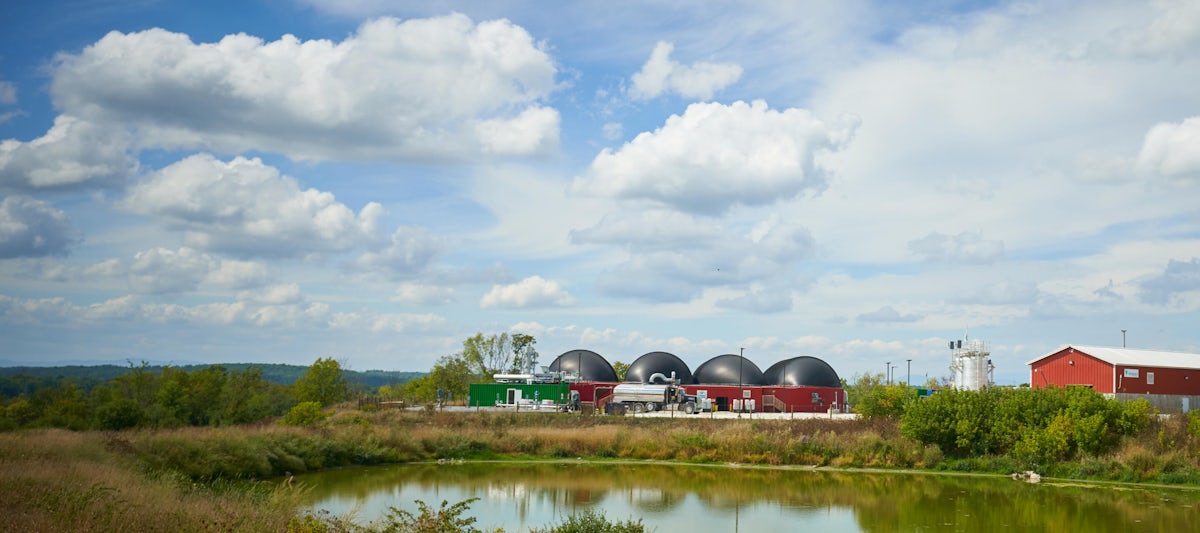
Organic waste in the United States remains abundant and largely untapped. A single food waste biomethane facility can serve more than 30 individual organic waste feedstock customers, pulling in material that would otherwise end up in landfills. Organic waste ban programs are expanding across the country, and stakeholders throughout the supply chain are increasingly seeking circular solutions that address multiple sustainability goals simultaneously.
The circular impact is real and measurable. Food waste diverted from landfills generates biomethane that can address Scope 1 and Scope 3 emissions for customers. The digestate byproduct closes the loop further by returning nutrients to the soil. This layered value is what distinguishes food waste biomethane from simpler alternatives.
What Is the Cost of Abatement for Food Waste Biomethane Compared to Other Fuels?
When evaluating alternative fuels, carbon intensity is the universal measuring stick regardless of which policy framework or methodology a market uses. Analyzed through the Argonne GREET model — the most established lifecycle assessment tool in the U.S., and the reference basis for California's CA-GREET and Japan's METI threshold — food waste biomethane stands out clearly:
- It requires smaller volumes of fuel to achieve the same emissions impact as other alternatives.
- It delivers the lowest cost per ton of CO₂-equivalent abated across commercially available pathways.
When system boundaries are accurately captured (e.g. including avoided emissions from landfill diversion and the credit from digestate), food waste biomethane can achieve a carbon intensity score as low as -150 to -100 CI. That is a deeply negative carbon intensity that is available today, not in some future technology scenario.
How Are Global Carbon Intensity Frameworks Converging, and What Does That Mean for Biomethane Buyers?
The largest biomethane markets globally are already CI-sensitive, and that sensitivity is only increasing. Regulatory frameworks like the U.S. Renewable Fuel Standard (RFS), California's Low Carbon Fuel Standard (LCFS), and emerging structures like Japan's METI framework all reference CI parameters. The GHG Protocol is also considering CI-sensitive provisions in its Actions and Market Instruments framework. The trajectory is toward more stringent thresholds over time.
For companies building biomethane strategies today, this is not a regulatory risk to hedge against; it is instead a compliance roadmap to get ahead of.
How Does Food Waste Biomethane Compare to Landfill Gas and e-Methane for Long-Term Compliance?
Landfill gas and e-methane are rightly recognized as important pillars of any biomethane strategy. But food waste biomethane complements both in ways that matter for long-term portfolio construction:
- Affordable: lowest-cost abatement pathway available today
- Deployable now: no waiting on future infrastructure buildout
- Broadly marketable: opens access to CI-sensitive markets beyond those served by landfill gas alone
- Compliance-resilient: full traceability and a pathway to meet increasingly stringent CI thresholds
The question isn't whether food waste biomethane fits. The question is whether a portfolio without it can remain competitive as markets tighten.
Can International Buyers Source Food Waste Biomethane from the United States?
For companies and utilities outside the U.S. looking to diversify their clean fuel supply chains, U.S.-sourced biomethane offers clear chain-of-custody traceability that aligns directly with how frameworks like METI consider certification and provenance.
Further, one of biomethane's most compelling advantages for international trade is that it requires no new export infrastructure. Injected into the existing U.S. natural gas pipeline network, it can be liquefied at existing LNG export terminals and shipped to markets in Asia and Europe using the same vessels and receiving infrastructure already handling conventional LNG.
The solution is one of the fastest and most capital-efficient pathways to decarbonizing gas supply chains. The infrastructure, the feedstock supply, and the regulatory clarity are all in place. The opportunity is here now.